
On the basis of recent changes to blood pressure (BP) guidelines,1 some 46% of Americans (a further 31 million people) are now classified as having hypertension (BP ≥130/80 mm Hg). This new classification recognizes the recent clinical trial evidence on the benefits of lower BP targets2 and, among other factors, emphasizes the importance of considering how nonpharmacological strategies (ie, lifestyle modification) can be better incorporated into broader prevention messages.3 In this context, and with conventional guidelines focusing on moderate-vigorous physical activity, there is unrealized potential for benefitting a large proportion of the at-risk population through broadening the range of physical activity options in ways that might be more amenable to lifetime adherence.
Although the benefits of a physically active lifestyle for overall cardiometabolic health, including BP control, are well known,4–7 a large and growing proportion of the global population is physically inactive.8,9 Worksites, schools, homes, and public spaces are physically engineered and socially arranged in ways that minimize regular movement and muscular activity and maximize the time spent sitting. This is against a background of unprecedented demographic shifts associated with the aging of populations, with higher proportions experiencing more years of frailty, a range of chronic noncommunicable diseases and risk factors, and poorer physical function and quality of life. Aside from contributing significantly to increases in healthcare costs, these combined factors represent a formidable set of clinical and public health challenges.
The contribution of low rates of participation in moderate-vigorous physical activity to the chronic disease burden has provided the impetus to explore the efficacy of physical activity options that are more amenable to lifetime adherence and that have broader population reach. In this regard, emerging strategies focusing on reducing and changing the patterns of sedentary behaviors (put simply, too much sitting) may have potential for lowering the incidence and prevalence of hypertension, as well as minimizing medication use in those already treated.
Through a hypertension lens, this review focuses on the potential health implications and some of the plausible countermeasures for the high volumes of prolonged sitting that now characterize modern lifestyles. We synthesize findings on the specific relationships of sedentary behavior with BP, which primarily are from observational and acute experimental studies, including a discussion on the relevant cardiovascular mechanisms. We also consider what will need to be better understood as a basis for evidence-based recommendations on sedentary time in the context of BP control and identify evidence gaps for future research.
Sedentary Behavior: a Newly Identified Element for Chronic Disease Risk and a Target for Management
Regular moderate-vigorous physical activity is well established as an effective tool in the prevention and management of multiple chronic diseases, including hypertension.4,7 However, in recent years, sedentary behavior, defined as any waking behavior characterized by an energy expenditure ≤1.5 metabolic equivalents while in a sitting or reclining posture, has received increasing attention as a clinical and population health problem that is additional to insufficient moderate-vigorous physical activity.10 Reasons for this new perspective around sedentary behavior largely stem from 3 key points (expanded below). For clarity and distinction, we refer to recommended amounts of moderate- to vigorous-intensity physical activity as exercise and utilize the terms sitting and sedentary behavior interchangeably throughout this article.7
-
Modest uptake and adherence to exercise guidelines: despite the multitude of potential health benefits derived from regular physical activity, population uptake is low. One-third of many adult populations (about 1.5 billion people globally) and four-fifths of adolescents do not adhere to minimum recommended levels of moderate-vigorous physical activity.8 Although leisure-related physical activity levels have tended to remain relatively steady over time, physical activity at work, in the domestic environment and in transportation, has all decreased in recent decades.8,9 Sustained and growing concerns also exist around the limited uptake and adherence to exercise guidelines in longer term trials11 and in accordance with national/global activity guidelines, particularly for older adults and in deconditioned/clinical populations.8,12–15
-
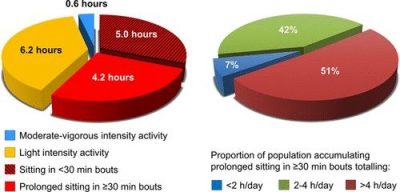
High volume of waking hours spent sedentary: in developed countries, and in the rapidly urbanizing populations of developing countries, sedentary behaviors have become the primary default behavioral option, inextricably embedded in work, school, transport, and leisure time. Data obtained from studies using accelerometers, mainly from America and Australia, indicate that adults spend on average 55% to 70% of their waking hours (or >8–10 hours/day) engaged in sedentary behaviors.16–18 Furthermore, recent Australian-based data suggest that just under half of the ≈9 hours of total sitting time (as measured by posture-sensitive accelerometers)19 is spent in prolonged unbroken bouts of >30 minutes and that just over half of all adults accumulated >4 hours per day of their sitting time in this manner (Figure 1).
-
Evidence on the associations of total sedentary time, and its pattern of accumulation, with cardiometabolic risk: prospective epidemiological evidence suggests that high volumes of sedentary time are associated with premature mortality and cardiometabolic risk biomarkers for type 2 diabetes mellitus, cardiovascular disease, and certain cancers. These deleterious associations are partly moderated by time spent in moderate-vigorous physical activity but are particularly evident in those who undertake insufficient or no moderate-vigorous physical activity.7,20,21 Furthermore, accumulating observational and experimental evidence indicates that specific patterns of sedentary time (ie, whether sitting is undertaken in prolonged or regular intermittent bouts) may be differentially associated with a number of cardiometabolic risk biomarkers and premature mortality.19,22–25 For example, a recent large-scale observational study found that both total sedentary time and prolonged uninterrupted sedentary bouts were associated with an increased risk for all-cause mortality, after controlling for moderate-vigorous physical activity and traditional cardiovascular risk factors.24 Another recent cross-sectional study, using inclinometer data from a subset of Australian-based participants (also see Figure 1 from the same cohort), showed that both greater amounts of sitting time and prolonged sitting time were deleteriously associated with waist circumference, body mass index, HDL cholesterol, triglycerides, 2-hour postload glucose, and fasting plasma glucose.23
Figure 1. Unpublished data showing how a subsample of Australian adults (n=717; aged 36–80 y) allocated their physically active and sitting time behaviors on average during waking hours (derived from both ActiGraph and ActivPAL activity monitors and normalized to 16 h/d). These data highlight the high volumes of sitting time typically observed and the proportion of people who accumulated sitting time in prolonged unbroken bouts (≥30 min). Note that moderate-vigorous–intensity activity is calculated based on every minute of activity accumulated during the day (ie, not just in exercise bouts of ≥10 min).
As a result, leading health agencies, such as the American Heart Association26 and the American Diabetes Association,27 have begun to acknowledge the likely clinical and population health impact of changing sedentary behaviors. Consideration of the mechanistic linkages of reducing and breaking up prolonged sitting with BP control and hypertension is highly relevant in this context. Indeed, evidence from epidemiological observational studies and a new body of findings from acute experimental trials can provide helpful insights.
Sedentary Behavior and BP Control
Measurement Challenges
There are significant challenges in objective quantification of both physical activity patterns and BP, which make relational investigations difficult.28,29 Most observational studies examining associations of sedentary behavior with BP and hypertension have typically relied on self-reported daily sitting or television/screen viewing time—methods that are susceptible to recall and response bias, social desirability, and underreporting or overreporting.28 Accelerometer-derived measures of movement and posture have been used recently to more “objectively” characterize sedentary and active behaviors because they are less subject to the biases that are inherent to self-report. However, they are not without limitations. For example, these newer methods cannot determine the behavioral contexts (ie, the location and purpose of these behaviors), and results may be influenced by wear-time differences, some activity misclassification (depending on device type/location), and data analysis approaches.
Particularly under conditions of normal daily living, BP measurement is associated with additional challenges. BP is an inherently labile parameter, with considerable temporal variation from heart beat to heart beat and across the 24-hour day. Thus, interpretation of a single time-of-day BP must be in a behavioral context that considers additional factors, such as dietary and fluid intake, physical activity, emotions, stress, and drugs (including caffeine and nicotine). In addition, BP measurements can be dramatically affected by the white coat or masked effects in clinic/office settings and is often measured under a variety of conditions (eg, postures) with differing preceding rest periods. Although not without limitations, 24-hour ambulatory BP has better prognostic value than single office BP measurements and is thus considered the reference standard to diagnose hypertension according to certain groups.29
The above measurement challenges likely contribute to variability in observational evidence on the associations of sedentary behavior with BP and hypertension (almost always assessed via resting office BP). Indeed, such evidence to date has been quite heterogeneous and inconsistent,30–34 with relatively small mean effect sizes.
Observational Evidence
In a recent systematic review and meta-analysis, Lee and Wong35 examined the associations of time spent in sedentary behaviors with BP in both adults and children. Of the 28 studies included in the meta-analysis (8 longitudinal and 20 cross-sectional), 10 assessed sedentary behavior via accelerometry, and the remainder used self-report measures (ie, television/screen viewing time, sitting time, or both). Results from this meta-analysis revealed that for each hour increase in self-reported sedentary behavior, there was an associated small increase in systolic and diastolic BP of 0.06 (95% CI, 0.01–0.11) and 0.20 (95% CI, 0.10–0.29) mm Hg, respectively. Additionally, for each hour increase in sedentary behavior, there was a 2% elevation in risk for hypertension (odds ratio, 1.02; 95% CI, 1.003–1.03).
Interestingly, no statistically significant associations were observed when sedentary time was assessed via accelerometry, although systolic BP trended at 0.10 (95% CI, −0.001 to 0.21; P=0.06) mm Hg.35 These discrepancies between the self-report and device-based exposure measures suggest either differences in measurement variability, validity, and reliability (for both the sedentary behavior exposures and the resting BP outcomes), poorer compliance with the use of the accelerometers (which has been shown to be lower in those with hypertension36), or that the disparity in timing of office BP measurements in relation to the active/sedentary behaviors and other factors (as mentioned previously) may also be important.
In one of the few observational studies to utilize both 7-day accelerometry and ambulatory BP measures, Hamer et al37 showed in a sample of 216 middle-aged black and white-African school teachers with or at high risk of hypertension that the positive associations of sedentary time with 24-hour BP (but not daytime or resting office BP) were primarily driven by the nighttime readings. Further analyses showed that participants in the highest sedentary tertile were also more likely to be nighttime nondippers (odds ratio, 2.11; 95% CI, 0.99–4.46; P=0.052) compared with those in the lowest sedentary tertile. These nighttime-specific BP findings for the more sedentary participants are intriguing because ambulatory BP-derived sleep BP (presence/absence of dipping) tends to be a more stable BP measure and is a stronger predictor of cardiovascular risk, independent of office BP or wake-time BP.38 The findings could be because of elevated nighttime sympathetic activation, which is consistent with the findings from 1 experimental study demonstrating higher plasma noradrenaline levels during prolonged sitting.39 Alternatively, BP readings are generally more stable nocturnally. However, there is also the potential for measurement issues because study participants were required to sleep in unfamiliar surroundings at the overnight clinical facility. Importantly, the study also showed that those who spent less daily time in light-intensity physical activity (the corollary of spending more time sedentary) had significantly higher 24-hour ambulatory and daytime systolic and diastolic BP, as well as higher resting systolic BP.
It is thus difficult to draw any firm conclusion from the observational evidence to date. The question of whether sedentary behavior is an acute BP stressor, as distinct from other conventional risk factors that contribute to sustained BP elevation (eg, age, obesity, and diabetes mellitus), is difficult to disentangle. Ambulatory BP measures may be better suited for studying the patterning of BP on days characterized by periods of prolonged sitting. Thus, further prospective study evidence using ambulatory BP methods, and with more detailed sensor-assessed measures of actual sitting patterns/postures and their context/setting, would be highly informative. Consideration of the specific population (eg, normotensive and uncomplicated hypertension and medication) in these contexts will also be important.
Experimental Evidence
Few studies have examined the effects of prolonged sitting on BP (see Table S1 in the online-only Data Supplement for a summary of the relevant acute studies published to date). Most studies,39–45 but not all,46,47 have observed significant systolic or diastolic BP-lowering effects when prolonged sitting time has been reduced or interrupted (mostly with walking breaks but also some with standing breaks), ranging from 1 to 16 mm Hg in magnitude. However, the majority of studies have generally included BP as a secondary end point, which may limit the rigor and interpretability of the BP findings.
Although not an entirely consistent phenomenon, reductions in BP with activity breaks in prolonged sitting have tended to be more modest in the physically active healthy younger populations, but most pronounced in older/at-risk populations and those with overt or prehypertension. For example, in inactive overweight/obese adults (over half of whom were classed as having prehypertension or hypertension), interrupting sitting time with brief bouts of either light- or moderate-intensity walking significantly lowered resting systolic and diastolic BP by ≈2 to 3 mm Hg.43 Similarly, reductions in resting systolic and diastolic BP of significantly greater magnitude (mean, ↓14–16 and ↓8–10 mm Hg, respectively) were shown when sitting was interrupted with either light-intensity walking or with simple resistance activities in adults with type 2 diabetes mellitus (of whom 88% were also hypertensive).39 These latter 2 laboratory-based studies support the contention that the magnitude of BP lowering by interrupting sitting time, or the BP increase with prolonged uninterrupted sitting, may be greater in hypertensive compared with normotensive groups. Moreover, BP reductions in these 2 studies were established on top of standard antihypertensive medications.
To further explore the hypothesis that those with hypertension may be more susceptible to BP elevation with prolonged sitting exposures, or derive more benefit from reducing and breaking up sitting time, we pooled data from 4 separate laboratory-based randomized crossover trials. These studies examined the BP responses to prolonged uninterrupted sitting versus sitting interrupted by regular 2- to 3-minute walking breaks (Figure 2A) or by regular 3-minute simple resistance activity breaks (half squats, calf raises, gluteal contractions, and knee raises; Figure 2B) in overweight/obese adults with and without hypertension. Figure 2 and accompanying Table S2 illustrate 2 key points:
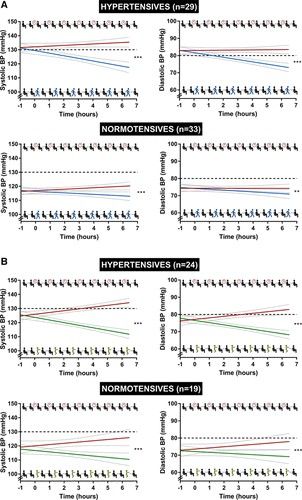
Figure 2. Temporal changes in systolic and diastolic blood pressure (BP) of pooled data from 4 separate crossover trials39,43,73,85 employing similar experimental protocols in individuals with and without hypertension. A, Lines represent line of best fit (with 95% CI, dotted lines) for uninterrupted sitting (red line) and sitting interrupted with short 2–3-min walking breaks (blue line) every 20–30 min after a 1-h steady-state period. B, Lines represent line of best fit (with 95% CI, dotted lines) for uninterrupted sitting (red line) and sitting interrupted with short 3-min simple resistance activities (green line) every 30 min after a 1-h steady-state period. Hypertensive individuals defined by a combination of clinical diagnosis/medication use or BP ≥130/80 mm Hg at screening visit. Solid dashed line represents new US clinical thresholds for hypertension (>130/80 mm Hg).1 Difference in slopes according to a linear mixed effects model adjusted for age, sex, body mass index, treatment order, and baseline values, ***P<0.001, **P=0.002 (see Table S2 for further details on the statistical models/results).
-
Prolonged uninterrupted sitting appears to evoke increases in both systolic and diastolic BP in a manner proportional to the length of time spent sitting, and the magnitude of these changes is generally greater and more clinically relevant in those with hypertension compared with normotensives and
-
Regular interruptions in prolonged sitting with either light-walking breaks or simple resistance activity breaks reduce both systolic and diastolic BP, but by a greater magnitude for simple resistance activity breaks, in both normotensive and hypertensive populations.
The simple resistance activity breaks incorporated into these recent trials were designed to provide an alternative option to walking breaks, which usually obliges a person to leave their immediate workspace/location. They require no specialized equipment and only small amounts of floor space. In addition, the compound/multijoint nature of these activities engages a significant muscle mass in contractile activity and when performed regularly, could increase functional capacity and insulin sensitivity through maintenance or increases in muscle mass and adaptations in metabolic enzymes. These factors may be particularly relevant for overweight and aging populations with hypertension,48 the vast majority of whom do not engage in sufficient moderate-vigorous or muscle-strengthening activities, in accordance with national activity guidelines.7,49 If these findings are corroborated by further studies and in a chronic context, there are potential implications for future targeting and optimization of physical activity/sedentary behavior interventions in these population groups.
Recent studies have also started to include more detailed ambulatory BP measures over consecutive days and while simulating free-living scenarios, which is providing insight into the sustained effects of sitting-reduction interventions. For example, Zeigler et al44,45 showed that prehypertensive, overweight/obese adults accumulating 2.5 hours of standing or light-intensity physical activity across the day equally reduced systolic and diastolic ambulatory BP both during and after working hours by ≈3 to 4 mm Hg and ≈2 to 13 mm Hg, respectively, compared with a simulated 8-hour seated workday. Using a comparable design and measures, Bhammer et al41 also showed similar reductions in systolic, diastolic, and mean arterial BP (≈5–6 mm Hg) with moderate- but not vigorous-intensity walking breaks, but these effects were only observed in the evening after the intervention period (outside of the laboratory).
The accumulation of the experimental findings described above is congruent with previous literature on the similarly beneficial impact of fractionized vs continuous exercise bouts,50–54 and the potential for a light-intensity physical activity threshold for BP lowering,55,56 which may even be related to simple postural changes (ie, sit-to-stand transitions) across the day. Further prospective and longer duration intervention studies of this nature, in more free-living settings and with ambulatory BP measures, will be important in elucidating whether prolonged sitting per se induces BP elevation. They will also assist in determining the efficacy and specificity of interventions that reduce and break up prolonged sitting time using a range of light- to moderate-intensity activities.
Teasing apart the impact of other confounding and interacting factors of everyday living, such as dietary, stress, and sleep patterns, will continue to be a challenge and may require more tailored study designs and advanced measurement and analytical approaches. The timing of BP measurements relative to activity and dietary factors will also be important, with a combination of parallel ambulatory BP measurements to determine BP reactivity in real-time, and well-standardized resting and ambulatory BP measures taken after the intervention period, to determine chronic BP changes.
Potential Physiological Mechanisms
Theoretical Considerations
The potential underlying biological mechanisms by which a bout of prolonged sitting may acutely modulate BP are multiple but ultimately must result from alterations in cardiac output or total peripheral resistance. In this context, mechanisms are likely to predominantly affect total peripheral resistance and to include metabolic, autonomic, and direct vascular mechanisms (Figure 3).
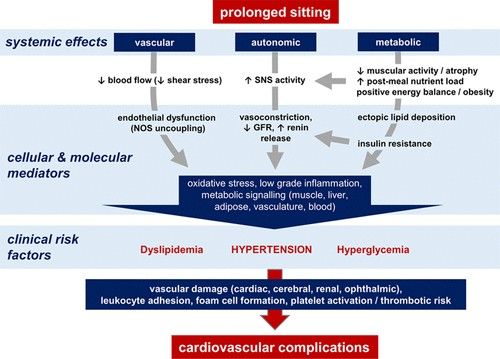
Figure 3. Hypothesized mechanisms by which prolonged sitting may influence risk for hypertension and cardiovascular complications. Systemic reductions in metabolic demand and blood flow, and elevated sympathetic nervous system (SNS) activity, may evoke concurrent decrements in insulin sensitivity and vascular function, promoting oxidative stress and low-grade inflammatory cascades. When prolonged sitting is habitual, these factors likely contribute to the development of hyperglycemia, dyslipidemia, and hypertension, promoting vascular damage and progression toward serious cardiovascular complications. GFR indicates glomerular filtration rate; and NOS, nitric oxide synthase.
The concept that metabolism controls blood flow and thus drives pressure is a potentially important consideration with respect to understanding how prolonged sitting might modulate BP. Prolonged sitting is characterized by low energy expenditure or metabolic demand, as measured by indirect57,58 and whole-room calorimetry,59 where the average energy cost of common sedentary behaviors (reclining, watching television, reading, and typing on a computer) is narrowly banded around ≈1.0 metabolic equivalent, even in the postprandial state.59 Metabolic demand is the key determinant of blood flow in all tissues, with multiple mechanisms linking the metabolic requirements of tissues in terms of oxygen and substrates (glucose and fatty acids), to blood supply.
Since metabolic demand is low during prolonged sitting, vasodilatory metabolites—including adenosine—are correspondingly low, and the caliber of capillaries is therefore minimized. It would be expected that low metabolic demand would result in closure of precapillary sphincters and the shutdown of nutritive capillary beds (Figure 4). Capillary closure as a result of low metabolic demand within muscles reduces the pressure differential with upstream feed arteries, thus reducing blood flow via simple hemodynamics. As a consequence, vascular shear stress is reduced, promoting vasoconstriction through associated endothelial mediators (ie, reduced NO [nitric oxide] and increased ET-1 [endothelin-1]). Low metabolic demand, therefore, has the potential to increase peripheral resistance and drive BP up through effects at multiple levels of the vascular tree. A seated posture creates bends and constrictions in major blood vessels of the lower limbs, particularly under the thighs.60 Such effects may result in simple mechanical increases in peripheral resistance but also promote turbulent blood flow patterns, which may have acute and chronic consequences for blood flow and pressure regulation.61,62
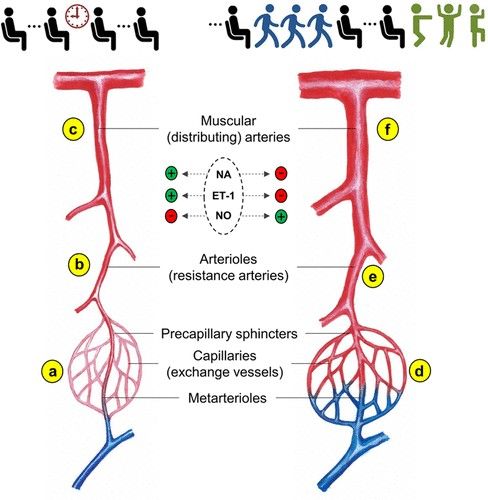
Figure 4. Hypothesized vascular mechanisms by which prolonged sitting may impact on blood pressure (BP) in contrast to sitting interrupted by regular active breaks. During prolonged sitting (left), (a) low metabolic/ATP demand within muscles results in low levels of vasodilator metabolites, constriction of precapillary arterioles, and closure of precapillary sphincters. This in turn results in blood being shunted through metarterioles. (b) Reduced pressure differential between capillaries and upstream muscular (distributing) arteries reduces blood flow and endothelial shear stress, promoting vasoconstriction through associated endothelial mediators (ie, reduced NO [nitric oxide] and increased ET-1 [endothelin-1]) and (c) reduced caliber of resistance arterioles, increasing peripheral resistance and BP. During brief 2–3-min activity bouts during prolonged sitting (right), (d) increased metabolic/ATP demand within muscles results in upregulation of vasodilator metabolites, dilation of precapillary arterioles, and relaxation of precapillary sphincters, promoting flow through nutritive capillaries. (e) The greater pressure differential between capillaries and upstream muscular (distributing) arteries increases blood flow and endothelial shear stress, promoting vasodilation through associated endothelial mediators and (f) increased caliber of resistance arterioles, reducing peripheral resistance and BP. Previously observed alterations in circulating noradrenaline (NA) during these 2 states are also depicted, along with ET-1 and NO bioavailability, for which the evidence is only preliminary.
A further consideration is that increased hydrostatic pressure and reduced venous return (ie, via insufficient calf muscle pump activity) while being seated also leads to fluid accumulation in the lower limbs that is proportional to the time spent sitting.63–65 This fluid accumulation during the day likely shifts rostral overnight and is hypothesized to predispose or exacerbate obstructive sleep apnea, particularly in those with congestive heart failure or at increased risk for obstructive apnea,66–68 which has been associated with nocturnal hypertension and nondipping BP patterns.67 Significant peripheral edema may also have implications for nighttime BP elevation via carotid baroreceptor unloading (because of increased interstitial pressure), reduced baroreceptor afferent activity, and, therefore, a reflex increase in efferent sympathetic activity. However, these mechanistic links remain untested in the context of prolonged sitting.
Over time, habitual physical inactivity and high volumes of prolonged sitting are likely to exacerbate weight gain, muscle atrophy, vascular rarefaction (reducing vascular volume), endothelial damage, and stiffening of large arteries, potentially contributing to sustained elevation in peripheral resistance and hypertension. In this context, controlled chronic studies are required to better understand any such longer term structural and functional changes.
Given that prolonged sitting occurs over hours, concurrent behaviors are integral to the consideration of mechanistic influences on BP. Foremost among these is food intake, which will induce a higher nutrient load in the context of prolonged sitting, where muscular activity and hence energy expenditure are relatively low. The exaggerated elevations in circulating glucose and insulin levels documented to occur with prolonged sitting in association with feeding would be expected to cause sympathoexcitation and noradrenaline release from arterial nerve terminals. This represents another plausible pathway that may contribute to BP elevation during a bout of prolonged sitting.
A final issue to consider is that physical activity-induced muscle contraction, whether through multiple breaks in sitting or via a continuous bout, will have opposing effects on mechanisms associated with prolonged sitting by promoting energy metabolism and vasodilation.
The autonomic effects of brief activity bouts are more complex. Although systolic BP, in particular, increases acutely during the performance of an activity (predominantly because of elevation in cardiac output), this is often followed by sympatholysis and reduced BP when activity ceases.69 Thus, as discussed in the previous section and Figure 2, differences in resting BP between a day of prolonged sitting and a day of prolonged sitting interrupted by brief activity bouts may be related to
-
increases in BP from baseline mediated by prolonged sitting and
-
decreases in BP from baseline mediated by activity bouts.
Although the physiological basis of the proposed mechanisms described above is sound, their validity requires testing in controlled laboratory studies that consider real-world behaviors, including food intake and stress, that are present in different contexts (eg, at work, during transportation, and in leisure time).
Evidence
As noted earlier, the body of evidence on the mechanisms by which prolonged sitting may impact BP is in its infancy. Although there are significant challenges to understanding the chronic BP effects in this context, acute physiological studies are providing some evidence to support the theoretical concepts discussed above. A number of studies have convincingly documented a prolonged sitting-induced increase in the accumulation of extravascular fluid in the legs63,65–68 and a decline in leg flow-mediated dilation or shear stress measured in the superficial femoral70–73 and popliteal74,75 arteries. These effects can be mitigated by various interventions promoting increased metabolic demand, muscle pump activity, and vasodilation, including frequent, short, low-intensity activity breaks,72,73 static standing,74 fidgeting,70 calf/lower leg exercises while sitting,68,76 bouts of cycling74 or walking,71 and heating.75
Direct measurement of vasoactive mediators (neurotransmitters and endothelium-derived factors) is challenging because blood levels do not accurately reflect the physiologically relevant concentrations within the vasculature and because some (eg, NO) have very short half-lives. There is, however, some evidence for elevation in vasoconstrictor mediators in response to prolonged sitting. In patients with type 2 diabetes mellitus, Dempsey et al39 observed an 11% to 18% increase in circulating noradrenaline in association with BP elevations of 10/5 mm Hg during prolonged sitting. These effects were mitigated by a magnitude similar to that typically achieved with pharmacological treatments if sustained,77 by interrupting prolonged sitting with brief bouts of light-intensity walking or simple resistance activities. It is also interesting that these effects were present even though 67% of participants in this study were medicated for hypertension and took their medications on the experimental days.
The expected downstream effects of sympathetic activation, including on the renin-angiotensin-aldosterone system, are yet to be studied in the context of prolonged sitting. Vasoactive endothelium-derived mediators are also likely important (Figures 3 and 4), but evidence on these and other such mechanistic candidates is currently lacking. As mentioned previously, downregulation of NO because of shear stress reductions is probable. In addition, there is consistent evidence that prolonged sitting increases insulin resistance relative to regular activity breaks, particularly in those who have type 2 diabetes mellitus.25 Insulin-resistant states are associated with marked impairments in insulin-mediated vasodilatation and capillary perfusion of skeletal muscle, through endothelial mechanisms involving impaired NO bioavailability78 and ET-1 upregulation.79–81 Indeed, a recent study in overweight/obese adults showed that ET-1 levels are higher during a bout of prolonged sitting compared with sitting interrupted every 30 minutes by 3 minutes of simple resistance activities; however, prolonged sitting per se did not elevate ET-1.73 Insulin may also promote the expression of proatherogenic mediators, including the intracellular adhesion and vascular cell adhesion molecules.82 Taken together, it could be speculated that prolonged sitting-induced shear stress reduction, combined with impairments in lower limb arterial function and dilation71,72,83 and the above cardiovascular disease risk factors, may promote a proatherogenic environment. However, further investigations are required to elucidate the specific vascular mechanisms relevant to prolonged sitting and its interruption by short activity breaks.
Mechanisms—Summary
Preliminary evidence suggests that the BP-relevant effects of prolonged sitting include reductions in conduit vessel flow and elevations in vasoactive mediators. Theoretical considerations indicate that these effects are likely driven by metabolic demand and capillary caliber, but studies to date have not extended to the microvessels. The mechanisms contributing to the effects of habitual prolonged sitting on BP during an extended (chronic) period are indeterminate and will be challenging to investigate. Current knowledge of the cellular and molecular mediators of vascular pathophysiology would implicate chronic low-grade inflammation and oxidative stress, as well as structural effects promoting vascular stiffening84 as intermediaries between acute hemodynamic changes and manifestations of clinical hypertension (Figure 3).
Summary and Future Directions
Through a hypertension lens, we have synthesized the available evidence on prolonged sitting with respect to BP control and highlighted potential new clinical and population health implications of sedentary behavior. In this context, we have discussed the plausible mechanisms and the associated emerging evidence. Although there are notable gaps in the currently available research literature on sedentary behavior and BP, accumulating experimental evidence points to the potential importance of reducing and breaking up prolonged periods of sitting for BP control, particularly in those who are more at risk, prehypertensive, or hypertensive.
These findings reemphasize the major role that all aspects along the human movement continuum, from sedentary behavior through to moderate-vigorous physical activity, can play in influencing overall health and cardiovascular function. Initial evidence also hints that prolonged sitting per se may exert both direct and indirect effects on BP; however, much still remains to be understood and clarified. This area of research may be particularly important in the context of the recently revised US guidelines for the diagnosis, treatment, and management of hypertension,2 which now recognize the vital importance of incorporating lifestyle approaches into broader clinical and population health messages. In this context, we can offer some directions for future research:
Longer Term Exposures and Interventions
There remains an urgent need for more chronic experimental trials and intervention study evidence from real-world settings, such as clinics and workplaces, with high-quality BP measures as primary outcomes, sufficient controls, and adequate sample sizes/statistical power to detect clinically meaningful changes. Such evidence will be required to determine the composition of sitting-reduction interventions that will have the largest impact on BP control and hypertension risk and whether BP changes can be sustained over longer periods. This would also contribute to the elucidation of potential mechanisms by which both acute and longer term interventions interrupting prolonged sitting may reduce BP.
More Advanced Measurement Tools and Analytic Methods
To fully understand the interrelationships between sedentary behavior, physical activity, and BP, it is crucial to have high-quality and accurate measures of both the exposure and the outcome. The integration of data from devices that are able to accurately assess both posture and activity patterns/intensities in real time, alongside both office and ambulatory BP measures, should be emphasized in future research. Additionally, advanced analytical techniques (such as isotemporal substitution modeling, compositional data analysis, and multivariate pattern analysis), will allow researchers to better account for the inevitable interdependencies and interactions between sedentary behaviors, physically active behaviors, and sleep across the 24-hour day, allowing for more meaningful conclusions.
Identifying the Optimal Doses, Patterning, and Timing of Sedentary Behaviors
Although there is acute evidence that reducing and breaking up prolonged sitting time with a range of light-moderate–intensity activities may be beneficial for BP control, much less is known about the specific dose-related and patterning effects of these behaviors. The “ideal” balance between sedentary behavior and physical activity for BP control is yet to be defined. Questions still remain around the optimal durations and thresholds of prolonged sitting time for BP control, and what range of postural or activity perturbations from sitting (ie, frequency, type/mode, duration, timing, and intensity) can produce the most benefit while maintaining adherence. These questions are inevitably complex because the ideal patterning of sedentary and physical activity behaviors is likely to be based on the requirements, context, and activity/health status of the subpopulation, rather than a one-size-fits-all approach. As such, more in-depth examination of the behavioral targets and feasibility to change in different populations will be informative in optimizing future intervention efforts.
Mechanisms, Contexts, and Interacting Effects
Evidence on the relative importance and integrated effects of the physiological states considered earlier in mediating the potential detrimental effects of prolonged sitting remains limited. Identifying the relevant mechanisms associated with prolonged sitting exposures, along with their relevant contexts, settings (eg, workplace, leisure, transportation, and television/screen time) and co-behaviors, will be important in providing an informed basis for clinical guidelines and public health targets. With this in mind, the impact on BP of reducing and breaking up prolonged sitting may interact with specific phenotypes, including but not limited to sex, menopausal status, adiposity, age, ethnicity, genetic profiles, sleep, dietary habits, smoking, alcohol intake, medications, current cardiorespiratory fitness and baseline physical activity levels, and populations with or at increased risk of chronic diseases. In the future, delivery of both broad-based preventive messages and tailored programs for particular at-risk groups will help maximize population health benefits, while minimizing the likelihood of ineffective approaches. Put simply: how, why, and where is it important to change sitting time, and in whom?
Conclusions and Recommendations
In closing, further evidence is still required to inform the efficacy and specificity of sedentary behavior recommendations for clinical practice and for public health policies aiming to reduce the burden of hypertension. Nonetheless, with the ubiquity of sedentary behaviors and the challenges for many in adhering to structured exercise guidelines, it is appropriate to advise “move more, sit less, more often” to improve BP control.26,27 Importantly, such advice should continue to be viewed as complementary in the context of other health behaviors, such as the promotion of regular moderate-vigorous physical activity, improving dietary and sleep habits, and minimizing stress. In addition to improving other risk factors associated with inactivity, a “whole-of-day” approach to reducing sitting time and increasing daily incidental movement may prove useful in its own right for improving BP control, particularly in at-risk populations and for those already managing hypertension. Such a strategy may also be an acceptable gateway for those who are physically inactive and highly sedentary, overweight/obese, elderly, deconditioned, and unable or reluctant to add/transition directly into structured exercise.
Acknowledgements
We thank Andrew Plant (www.andrewplant.com) for contributions to the artwork in Figure 4.
P.C. Dempsey, N. Owen, D.W. Dunstan, and B.A. Kingwell are supported by National Health and Medical Research Council of Australia research fellowships (No. 1142685, 1003960, 1078360, and 1059454) and by the Victorian Government’s Operational Infrastructure Support Program.
Footnotes
References
- 1. Whelton PK, Carey RM, Aronow WS, et al.. 2017 ACC/AHA/AAPA/ABC/ACPM/AGS/APhA/ASH/ASPC/NMA/PCNA Guideline for the prevention, detection, evaluation, and management of high blood pressure in adults: a report of the American College of Cardiology/American Heart Association Task Force on clinical practice guidelines.J Am Coll Cardiol. 2018; 71:e127–e248. doi: 10.1016/j.jacc.2017.11.006CrossrefMedlineGoogle Scholar
- 2. Wright JT, Williamson JD, Whelton PK, et al.. A randomized trial of intensive versus standard blood-pressure control.N Engl J Med. 2015; 373:2103–16.CrossrefMedlineGoogle Scholar
- 3. Godlee F. Pills are not the answer to unhealthy lifestyles.BMJ. 2018; 362.Google Scholar
- 4. Diaz KM, Shimbo D. Physical activity and the prevention of hypertension.Curr Hypertens Rep. 2013; 15:659–668. doi: 10.1007/s11906-013-0386-8CrossrefMedlineGoogle Scholar
- 5. Huai P, Xun H, Reilly KH, Wang Y, Ma W, Xi B. Physical activity and risk of hypertension: a meta-analysis of prospective cohort studies.Hypertension. 2013; 62:1021–1026. doi: 10.1161/HYPERTENSIONAHA.113.01965LinkGoogle Scholar
- 6. Liu X, Zhang D, Liu Y, Sun X, Han C, Wang B, Ren Y, Zhou J, Zhao Y, Shi Y, Hu D, Zhang M. Dose-response association between physical activity and incident hypertension: a systematic review and meta-analysis of cohort studies.Hypertension. 2017; 69:813–820. doi: 10.1161/HYPERTENSIONAHA.116.08994LinkGoogle Scholar
- 7. 2018 Physical Activity Guidelines Advisory Committee. 2018 Physical Activity Guidelines Advisory Committee Scientific Report. Washington, DC: U.S. Department of Health and Human Services, 2018. https://health.gov/paguidelines/second-edition/report.aspx. Accessed June 15, 2018.Google Scholar
- 8. Hallal PC, Andersen LB, Bull FC, Guthold R, Haskell W, Ekelund U; Lancet Physical Activity Series Working Group. Global physical activity levels: surveillance progress, pitfalls, and prospects.Lancet. 2012; 380:247–257. doi: 10.1016/S0140-6736(12)60646-1CrossrefMedlineGoogle Scholar
- 9. Ng SW, Popkin BM. Time use and physical activity: a shift away from movement across the globe.Obes Rev. 2012; 13:659–680. doi: 10.1111/j.1467-789X.2011.00982.xCrossrefMedlineGoogle Scholar
- 10. Tremblay MS, Aubert S, Barnes JD, Saunders TJ, Carson V, Latimer-Cheung AE, Chastin SFM, Altenburg TM, Chinapaw MJM; SBRN Terminology Consensus Project Participants. Sedentary Behavior Research Network (SBRN) – terminology consensus project process and outcome.Int J Behav Nutr Phys Act. 2017; 14:75. doi: 10.1186/s12966-017-0525-8CrossrefMedlineGoogle Scholar
- 11. Saida TGRH, Juul Sørensen T, Langberg H. Long-term exercise adherence after public health training in at-risk adults.Ann Phys Rehabil Med. 2017; 60:237–243. doi: 10.1016/j.rehab.2017.02.006CrossrefMedlineGoogle Scholar
- 12. Kohl HW, Craig CL, Lambert EV, Inoue S, Alkandari JR, Leetongin G, Kahlmeier S; Lancet Physical Activity Series Working Group. The pandemic of physical inactivity: global action for public health.Lancet. 2012; 380:294–305. doi: 10.1016/S0140-6736(12)60898-8CrossrefMedlineGoogle Scholar
- 13. Heath GW, Parra-Perez D, Sarmiento-Duenas OL, Anderson LB, Owen N, Goenka S, Brownson RC. Evidence-based physical activity intervention: Lessons from around the globe.Lancet. 2012; 380:272–81.CrossrefMedlineGoogle Scholar
- 14. Hallal PC, Bauman AE, Heath GW, Kohl HW, Lee IM, Pratt M. Physical activity: more of the same is not enough.Lancet. 2012; 380:190–191. doi: 10.1016/S0140-6736(12)61027-7CrossrefMedlineGoogle Scholar
- 15. Knuth AG, Hallal PC. Temporal trends in physical activity: a systematic review.J Phys Act Health. 2009; 6:548–559.CrossrefMedlineGoogle Scholar
- 16. Matthews CE, Chen KY, Freedson PS, Buchowski MS, Beech BM, Pate RR, Troiano RP. Amount of time spent in sedentary behaviors in the United States, 2003-2004.Am J Epidemiol. 2008; 167:875–881. doi: 10.1093/aje/kwm390CrossrefMedlineGoogle Scholar
- 17. Hagströmer M, Troiano RP, Sjöström M, Berrigan D. Levels and patterns of objectively assessed physical activity–a comparison between Sweden and the United States.Am J Epidemiol. 2010; 171:1055–1064. doi: 10.1093/aje/kwq069CrossrefMedlineGoogle Scholar
- 18. Dempsey PC, Owen N, Biddle SJ, Dunstan DW. Managing sedentary behavior to reduce the risk of diabetes and cardiovascular disease.Curr Diab Rep. 2014; 14:522. doi: 10.1007/s11892-014-0522-0CrossrefMedlineGoogle Scholar
- 19. Healy GN, Winkler EA, Owen N, Anuradha S, Dunstan DW. Replacing sitting time with standing or stepping: associations with cardio-metabolic risk biomarkers.Eur Heart J. 2015; 36:2643–2649. doi: 10.1093/eurheartj/ehv308CrossrefMedlineGoogle Scholar
- 20. Biswas A, Oh PI, Faulkner GE, Bajaj RR, Silver MA, Mitchell MS, Alter DA. Sedentary time and its association with risk for disease incidence, mortality, and hospitalization in adults: a systematic review and meta-analysis.Ann Intern Med. 2015; 162:123–132. doi: 10.7326/M14-1651CrossrefMedlineGoogle Scholar
- 21. Ekelund U, Brown WJ, Steene-Johannessen J, et al.. Do the associations of sedentary behaviour with cardiovascular disease mortality and cancer mortality differ by physical activity level? A systematic review and harmonised meta-analysis of data from 850 060 participants [published online July 10, 2018].Br J Sports Med. doi: 10.1136/bjsports-2017–098963. https://bjsm.bmj.com/content/early/2018/06/05/bjsports-2017-098963.Google Scholar
- 22. Chastin SF, Egerton T, Leask C, Stamatakis E. Meta-analysis of the relationship between breaks in sedentary behavior and cardiometabolic health.Obesity (Silver Spring). 2015; 23:1800–1810. doi: 10.1002/oby.21180CrossrefMedlineGoogle Scholar
- 23. Bellettiere J, Winkler EAH, Chastin SFM, Kerr J, Owen N, Dunstan DW, Healy GN. Associations of sitting accumulation patterns with cardio-metabolic risk biomarkers in Australian adults.PLoS One. 2017; 12:e0180119. doi: 10.1371/journal.pone.0180119CrossrefMedlineGoogle Scholar
- 24. Diaz KM, Howard VJ, Hutto B, Colabianchi N, Vena JE, Safford MM, Blair SN, Hooker SP. Patterns of sedentary behavior and mortality in U.S. middle-aged and older adults: a National Cohort Study.Ann Intern Med. 2017; 167:465–475. doi: 10.7326/M17-0212CrossrefMedlineGoogle Scholar
- 25. Dempsey PC, Owen N, Yates TE, Kingwell BA, Dunstan DW. Sitting less and moving more: improved glycaemic control for type 2 diabetes prevention and management.Curr Diab Rep. 2016; 16:114. doi: 10.1007/s11892-016-0797-4CrossrefMedlineGoogle Scholar
- 26. Young DR, Hivert MF, Alhassan S, Camhi SM, Ferguson JF, Katzmarzyk PT, Lewis CE, Owen N, Perry CK, Siddique J, Yong CM; Endorsed by The Obesity Society; Physical Activity Committee of the Council on Lifestyle and Cardiometabolic Health; Council on Clinical Cardiology; Council on Epidemiology and Prevention; Council on Functional Genomics and Translational Biology; and Stroke Council. Sedentary behavior and cardiovascular morbidity and mortality: a science advisory from the American Heart Association.Circulation. 2016; 134:e262–e279.LinkGoogle Scholar
- 27. Colberg SR, Sigal RJ, Yardley JE, Riddell MC, Dunstan DW, Dempsey PC, Horton ES, Castorino K, Tate DF. Physical activity/exercise and diabetes: a position statement of the American Diabetes Association.Diabetes Care. 2016; 39:2065–2079. doi: 10.2337/dc16-1728CrossrefMedlineGoogle Scholar
- 28. Healy GN, Clark BK, Winkler EA, Gardiner PA, Brown WJ, Matthews CE. Measurement of adults’ sedentary time in population-based studies.Am J Prev Med. 2011; 41:216–227. doi: 10.1016/j.amepre.2011.05.005CrossrefMedlineGoogle Scholar
- 29. Siu AL; U.S. Preventive Services Task Force. Screening for high blood pressure in adults: U.S. Preventive Services Task Force recommendation statement.Ann Intern Med. 2015; 163:778–786. doi: 10.7326/M15-2223CrossrefMedlineGoogle Scholar
- 30. Aadahl M, Kjaer M, Jørgensen T. Influence of time spent on TV viewing and vigorous intensity physical activity on cardiovascular biomarkers. The Inter 99 study.Eur J Cardiovasc Prev Rehabil. 2007; 14:660–665. doi: 10.1097/HJR.0b013e3280c284c5CrossrefMedlineGoogle Scholar
- 31. Beunza JJ, Martínez-González MA, Ebrahim S, Bes-Rastrollo M, Núñez J, Martínez JA, Alonso A. Sedentary behaviors and the risk of incident hypertension: the SUN Cohort.Am J Hypertens. 2007; 20:1156–1162. doi: 10.1016/j.amjhyper.2007.06.007MedlineGoogle Scholar
- 32. Healy GN, Dunstan DW, Salmon J, Shaw JE, Zimmet PZ, Owen N. Television time and continuous metabolic risk in physically active adults.Med Sci Sports Exerc. 2008; 40:639–645. doi: 10.1249/MSS.0b013e3181607421CrossrefMedlineGoogle Scholar
- 33. Jakes RW, Day NE, Khaw KT, Luben R, Oakes S, Welch A, Bingham S, Wareham NJ. Television viewing and low participation in vigorous recreation are independently associated with obesity and markers of cardiovascular disease risk: EPIC-Norfolk population-based study.Eur J Clin Nutr. 2003; 57:1089–1096. doi: 10.1038/sj.ejcn.1601648CrossrefMedlineGoogle Scholar
- 34. Sidney S, Sternfeld B, Haskell WL, Jacobs DR, Chesney MA, Hulley SB. Television viewing and cardiovascular risk factors in young adults: the CARDIA study.Ann Epidemiol. 1996; 6:154–159.CrossrefMedlineGoogle Scholar
- 35. Lee PH, Wong FK. The association between time spent in sedentary behaviors and blood pressure: a systematic review and meta-analysis.Sports Med. 2015; 45:867–880. doi: 10.1007/s40279-015-0322-yCrossrefMedlineGoogle Scholar
- 36. Lee PH, Macfarlane DJ, Lam TH. Factors associated with participant compliance in studies using accelerometers.Gait Posture. 2013; 38:912–917. doi: 10.1016/j.gaitpost.2013.04.018CrossrefMedlineGoogle Scholar
- 37. Hamer M, Bruwer EJ, de Ridder JH, Swanepoel M, Kengne AP, Cockeran M, Malan L. The association between seven-day objectively measured habitual physical activity and 24 h ambulatory blood pressure: the SABPA study.J Hum Hypertens. 2017; 31:409–414. doi: 10.1038/jhh.2016.93CrossrefMedlineGoogle Scholar
- 38. Hermida RC, Ayala DE, Fernández JR, Mojón A, Smolensky MH. Hypertension: new perspective on its definition and clinical management by bedtime therapy substantially reduces cardiovascular disease risk.Eur J Clin Invest. 2018; 48:e12909. doi: 10.1111/eci.12909CrossrefMedlineGoogle Scholar
- 39. Dempsey PC, Sacre JW, Larsen RN, Straznicky NE, Sethi P, Cohen ND, Cerin E, Lambert GW, Owen N, Kingwell BA, Dunstan DW. Interrupting prolonged sitting with brief bouts of light walking or simple resistance activities reduces resting blood pressure and plasma noradrenaline in type 2 diabetes.J Hypertens. 2016; 34:2376–2382. doi: 10.1097/HJH.0000000000001101CrossrefMedlineGoogle Scholar
- 40. Barone Gibbs B, Kowalsky RJ, Perdomo SJ, Taormina JM, Balzer JR, Jakicic JM. Effect of alternating standing and sitting on blood pressure and pulse wave velocity during a simulated workday in adults with overweight/obesity.J Hypertens. 2017; 35:2411–2418. doi: 10.1097/HJH.0000000000001463CrossrefMedlineGoogle Scholar
- 41. Bhammar DM, Sawyer BJ, Tucker WJ, Gaesser GA. Breaks in sitting time: effects on continuously monitored glucose and blood pressure.Med Sci Sports Exerc. 2017; 49:2119–2130. doi: 10.1249/MSS.0000000000001315CrossrefMedlineGoogle Scholar
- 42. Champion RB, Smith LR, Smith J, Hirlav B, Maylor BD, White SL, Bailey DP. Reducing prolonged sedentary time using a treadmill desk acutely improves cardiometabolic risk markers in male and female adults.J Sports Sci. 2018; 36:2484–2491. doi: 10.1080/02640414.2018.1464744CrossrefMedlineGoogle Scholar
- 43. Larsen RN, Kingwell BA, Sethi P, Cerin E, Owen N, Dunstan DW. Breaking up prolonged sitting reduces resting blood pressure in overweight/obese adults.Nutr Metab Cardiovasc Dis. 2014; 24:976–982. doi: 10.1016/j.numecd.2014.04.011CrossrefMedlineGoogle Scholar
- 44. Zeigler ZS, Mullane SL, Crespo NC, Buman MP, Gaesser GA. Effects of standing and light-intensity activity on ambulatory blood pressure.Med Sci Sports Exerc. 2016; 48:175–181. doi: 10.1249/MSS.0000000000000754CrossrefMedlineGoogle Scholar
- 45. Zeigler ZS, Swan PD, Bhammar DM, Gaesser GA. Walking workstation use reduces ambulatory blood pressure in adults with prehypertension.J Phys Act Health. 2015; 12(suppl 1):S119–S127. doi: 10.1123/jpah.2013-0487CrossrefMedlineGoogle Scholar
- 46. Bailey DP, Locke CD. Breaking up prolonged sitting with light-intensity walking improves postprandial glycemia, but breaking up sitting with standing does not.J Sci Med Sport. 2015; 18:294–298. doi: 10.1016/j.jsams.2014.03.008CrossrefMedlineGoogle Scholar
- 47. Younger AM, Pettitt RW, Sexton PJ, Maass WJ, Pettitt CD. Acute moderate exercise does not attenuate cardiometabolic function associated with a bout of prolonged sitting.J Sports Sci. 2016; 34:658–663. doi: 10.1080/02640414.2015.1068435CrossrefMedlineGoogle Scholar
- 48. Cornelissen VA, Fagard RH, Coeckelberghs E, Vanhees L. Impact of resistance training on blood pressure and other cardiovascular risk factors: a meta-analysis of randomized, controlled trials.Hypertension. 2011; 58:950–958. doi: 10.1161/HYPERTENSIONAHA.111.177071LinkGoogle Scholar
- 49. Bennie JA, Pedisic Z, van Uffelen JG, Charity MJ, Harvey JT, Banting LK, Vergeer I, Biddle SJ, Eime RM. Pumping iron in Australia: prevalence, trends and sociodemographic correlates of muscle strengthening activity participation from a national sample of 195,926 adults.PLoS One. 2016; 11:e0153225. doi: 10.1371/journal.pone.0153225CrossrefMedlineGoogle Scholar
- 50. Angadi SS, Weltman A, Watson-Winfield D, Weltman J, Frick K, Patrie J, Gaesser GA. Effect of fractionized vs continuous, single-session exercise on blood pressure in adults.J Hum Hypertens. 2010; 24:300–302. doi: 10.1038/jhh.2009.110CrossrefMedlineGoogle Scholar
- 51. Bhammar DM, Angadi SS, Gaesser GA. Effects of fractionized and continuous exercise on 24-h ambulatory blood pressure.Med Sci Sports Exerc. 2012; 44:2270–2276. doi: 10.1249/MSS.0b013e3182663117CrossrefMedlineGoogle Scholar
- 52. Miyashita M, Burns SF, Stensel DJ. Accumulating short bouts of brisk walking reduces postprandial plasma triacylglycerol concentrations and resting blood pressure in healthy young men.Am J Clin Nutr. 2008; 88:1225–1231. doi: 10.3945/ajcn.2008.26493MedlineGoogle Scholar
- 53. Miyashita M, Burns SF, Stensel DJ. Accumulating short bouts of running reduces resting blood pressure in young normotensive/pre-hypertensive men.J Sports Sci. 2011; 29:1473–1482. doi: 10.1080/02640414.2011.593042CrossrefMedlineGoogle Scholar
- 54. Park S, Rink LD, Wallace JP. Accumulation of physical activity leads to a greater blood pressure reduction than a single continuous session, in prehypertension.J Hypertens. 2006; 24:1761–1770. doi: 10.1097/01.hjh.0000242400.37967.54CrossrefMedlineGoogle Scholar
- 55. Pescatello LS, Franklin BA, Fagard R, Farquhar WB, Kelley GA, Ray CA; American College of Sports Medicine. American College of Sports Medicine position stand. Exercise and hypertension.Med Sci Sports Exerc. 2004; 36:533–553.CrossrefMedlineGoogle Scholar
- 56. Thompson PD, Crouse SF, Goodpaster B, Kelley D, Moyna N, Pescatello L. The acute versus the chronic response to exercise.Med Sci Sports Exerc. 2001; 33(6suppl):S438–S445; discussion S452.CrossrefMedlineGoogle Scholar
- 57. Júdice PB, Hamilton MT, Sardinha LB, Zderic TW, Silva AM. What is the metabolic and energy cost of sitting, standing and sit/stand transitions?Eur J Appl Physiol. 2016; 116:263–273. doi: 10.1007/s00421-015-3279-5CrossrefMedlineGoogle Scholar
- 58. Mansoubi M, Pearson N, Clemes SA, Biddle SJ, Bodicoat DH, Tolfrey K, Edwardson CL, Yates T. Energy expenditure during common sitting and standing tasks: examining the 1.5 MET definition of sedentary behaviour.BMC Public Health. 2015; 15:516. doi: 10.1186/s12889-015-1851-xCrossrefMedlineGoogle Scholar
- 59. Newton RL, Han H, Zderic T, Hamilton MT, Hamilton M. The energy expenditure of sedentary behavior: a whole room calorimeter study.PLoS One. 2013; 8:e63171. doi: 10.1371/journal.pone.0063171CrossrefMedlineGoogle Scholar
- 60. Padilla J, Fadel PJ. Prolonged sitting leg vasculopathy: contributing factors and clinical implications.Am J Physiol Heart Circ Physiol. 2017; 313:H722–H728. doi: 10.1152/ajpheart.00326.2017CrossrefMedlineGoogle Scholar
- 61. Thosar SS, Bielko SL, Wiggins CC, Wallace JP. Differences in brachial and femoral artery responses to prolonged sitting.Cardiovasc Ultrasound. 2014; 12:50. doi: 10.1186/1476-7120-12-50CrossrefMedlineGoogle Scholar
- 62. Thosar SS, Johnson BD, Johnston JD, Wallace JP. Sitting and endothelial dysfunction: the role of shear stress.Med Sci Monit. 2012; 18:RA173–RA180.CrossrefMedlineGoogle Scholar
- 63. Mittermayr M, Fries D, Gruber H, Peer S, Klingler A, Fischbach U, Gunga HC, Koralewski E, Faulhaber M, Simmer M, Schobersberger W. Leg edema formation and venous blood flow velocity during a simulated long-haul flight.Thromb Res. 2007; 120:497–504. doi: 10.1016/j.thromres.2006.12.012CrossrefMedlineGoogle Scholar
- 64. Pottier M, Dubreuil A, Monod H. The effects of sitting posture on the volume of the foot.Ergonomics. 1969; 12:753–758. doi: 10.1080/00140136908931092CrossrefMedlineGoogle Scholar
- 65. Winkel J, Jørgensen K. Evaluation of foot swelling and lower-limb temperatures in relation to leg activity during long-term seated office work.Ergonomics. 1986; 29:313–328. doi: 10.1080/00140138608968267CrossrefMedlineGoogle Scholar
- 66. Redolfi S, Yumino D, Ruttanaumpawan P, Yau B, Su MC, Lam J, Bradley TD. Relationship between overnight rostral fluid shift and obstructive sleep apnea in nonobese men.Am J Respir Crit Care Med. 2009; 179:241–246. doi: 10.1164/rccm.200807-1076OCCrossrefMedlineGoogle Scholar
- 67. White LH, Bradley TD, Logan AG. Pathogenesis of obstructive sleep apnoea in hypertensive patients: role of fluid retention and nocturnal rostral fluid shift.J Hum Hypertens. 2015; 29:342–350. doi: 10.1038/jhh.2014.94CrossrefMedlineGoogle Scholar
- 68. Singh B, Yadollahi A, Lyons O, Alshaer H, Bradley TD. The effect of sitting and calf activity on leg fluid and snoring.Respir Physiol Neurobiol. 2017; 240:1–7. doi: 10.1016/j.resp.2017.02.008CrossrefMedlineGoogle Scholar
- 69. Floras JS, Sinkey CA, Aylward PE, Seals DR, Thoren PN, Mark AL. Postexercise hypotension and sympathoinhibition in borderline hypertensive men.Hypertension. 1989; 14:28–35.LinkGoogle Scholar
- 70. Morishima T, Restaino RM, Walsh LK, Kanaley JA, Fadel PJ, Padilla J. Prolonged sitting-induced leg endothelial dysfunction is prevented by fidgeting.Am J Physiol Heart Circ Physiol. 2016; 311:H177–H182. doi: 10.1152/ajpheart.00297.2016CrossrefMedlineGoogle Scholar
- 71. Restaino RM, Holwerda SW, Credeur DP, Fadel PJ, Padilla J. Impact of prolonged sitting on lower and upper limb micro- and macrovascular dilator function.Exp Physiol. 2015; 100:829–838. doi: 10.1113/EP085238CrossrefMedlineGoogle Scholar
- 72. Thosar SS, Bielko SL, Mather KJ, Johnston JD, Wallace JP. Effect of prolonged sitting and breaks in sitting time on endothelial function.Med Sci Sports Exerc. 2015; 47:843–849. doi: 10.1249/MSS.0000000000000479CrossrefMedlineGoogle Scholar
- 73. Climie RE, Wheeler MJ, Grace M, Lambert E, Cohen N, Owen N, Kingwell B, Dunstan DW, Green DJ. Simple intermittent resistance activity mitigates the detrimental effect of prolonged unbroken sitting on arterial function in overweight and obese adults [published online September 6, 2018].J Appl Physiol. doi: 10.1152/japplphysiol.00544.2018. https://www.physiology.org/doi/abs/10.1152/japplphysiol.00544.2018.Google Scholar
- 74. Morishima T, Restaino RM, Walsh LK, Kanaley JA, Padilla J. Prior exercise and standing as strategies to circumvent sitting-induced leg endothelial dysfunction.Clin Sci (Lond). 2017; 131:1045–1053. doi: 10.1042/CS20170031CrossrefMedlineGoogle Scholar
- 75. Restaino RM, Walsh LK, Morishima T, Vranish JR, Martinez-Lemus LA, Fadel PJ, Padilla J. Endothelial dysfunction following prolonged sitting is mediated by a reduction in shear stress.Am J Physiol Heart Circ Physiol. 2016; 310:H648–H653. doi: 10.1152/ajpheart.00943.2015CrossrefMedlineGoogle Scholar
- 76. Noddeland H, Winkel J. Effects of leg activity and ambient barometric pressure on foot swelling and lower-limb skin temperature during 8 h of sitting.Eur J Appl Physiol Occup Physiol. 1988; 57:409–414.CrossrefMedlineGoogle Scholar
- 77. Law MR, Morris JK, Wald NJ. Use of blood pressure lowering drugs in the prevention of cardiovascular disease: meta-analysis of 147 randomised trials in the context of expectations from prospective epidemiological studies.BMJ. 2009; 338:b1665.CrossrefMedlineGoogle Scholar
- 78. Keske MA, Dwyer RM, Russell RD, Blackwood SJ, Brown AA, Hu D, Premilovac D, Richards SM, Rattigan S. Regulation of microvascular flow and metabolism: an overview.Clin Exp Pharmacol Physiol. 2017; 44:143–149. doi: 10.1111/1440-1681.12688CrossrefMedlineGoogle Scholar
- 79. Reynolds LJ, Credeur DP, Manrique C, Padilla J, Fadel PJ, Thyfault JP. Obesity, type 2 diabetes, and impaired insulin-stimulated blood flow: role of skeletal muscle NO synthase and endothelin-1.J Appl Physiol (1985). 2017; 122:38–47. doi: 10.1152/japplphysiol.00286.2016CrossrefMedlineGoogle Scholar
- 80. Cardillo C, Campia U, Bryant MB, Panza JA. Increased activity of endogenous endothelin in patients with type II diabetes mellitus.Circulation. 2002; 106:1783–1787.LinkGoogle Scholar
- 81. Muniyappa R, Sowers JR. Role of insulin resistance in endothelial dysfunction.Rev Endocr Metab Disord. 2013; 14:5–12. doi: 10.1007/s11154-012-9229-1CrossrefMedlineGoogle Scholar
- 82. Montagnani M, Golovchenko I, Kim I, Koh GY, Goalstone ML, Mundhekar AN, Johansen M, Kucik DF, Quon MJ, Draznin B. Inhibition of phosphatidylinositol 3-kinase enhances mitogenic actions of insulin in endothelial cells.J Biol Chem. 2002; 277:1794–1799. doi: 10.1074/jbc.M103728200CrossrefMedlineGoogle Scholar
- 83. McManus AM, Ainslie PN, Green DJ, Simair RG, Smith K, Lewis N. Impact of prolonged sitting on vascular function in young girls.Exp Physiol. 2015; 100:1379–1387. doi: 10.1113/EP085355CrossrefMedlineGoogle Scholar
- 84. Germano-Soares AH, Andrade-Lima A, Menêses AL, Correia MA, Parmenter BJ, Tassitano RM, Cucato GG, Ritti-Dias RM. Association of time spent in physical activities and sedentary behaviors with carotid-femoral pulse wave velocity: a systematic review and meta-analysis.Atherosclerosis. 2018; 269:211–218. doi: 10.1016/j.atherosclerosis.2018.01.009CrossrefMedlineGoogle Scholar
- 85. Larsen RN, Kingwell BA, Robinson C, Hammond L, Cerin E, Shaw JE, Healy GN, Hamilton MT, Owen N, Dunstan DW. Breaking up of prolonged sitting over three days sustains, but does not enhance, lowering of postprandial plasma glucose and insulin in overweight and obese adults.Clin Sci (Lond). 2015; 129:117–127. doi: 10.1042/CS20140790CrossrefMedlineGoogle Scholar
-
 November 2018
Vol 72, Issue 5Download: 3,434

Sat, 04 Jan 2020 22:44:45 +0000