
Publicación seleccionada
Este artículo se ha publicado originalmente en academic.oup.com
The Hygia Chronotherapy Trial, conducted within the clinical primary care setting, was designed to test whether bedtime in comparison to usual upon awakening hypertension therapy exerts better cardiovascular disease (CVD) risk reduction.
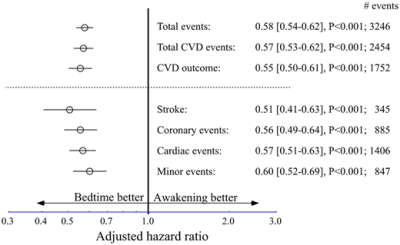
In this multicentre, controlled, prospective endpoint trial, 19 084 hypertensive patients (10 614 men/8470 women, 60.5 ± 13.7 years of age) were assigned (1:1) to ingest the entire daily dose of ≥1 hypertension medications at bedtime (n = 9552) or all of them upon awakening (n = 9532). At inclusion and at every scheduled clinic visit (at least annually) throughout follow-up, ambulatory blood pressure (ABP) monitoring was performed for 48 h. During the 6.3-year median patient follow-up, 1752 participants experienced the primary CVD outcome (CVD death, myocardial infarction, coronary revascularization, heart failure, or stroke). Patients of the bedtime, compared with the upon-waking, treatment-time regimen showed significantly lower hazard ratio—adjusted for significant influential characteristics of age, sex, type 2 diabetes, chronic kidney disease, smoking, HDL cholesterol, asleep systolic blood pressure (BP) mean, sleep-time relative systolic BP decline, and previous CVD event—of the primary CVD outcome [0.55 (95% CI 0.50–0.61), P < 0.001] and each of its single components (P < 0.001 in all cases), i.e. CVD death [0.44 (0.34–0.56)], myocardial infarction [0.66 (0.52–0.84)], coronary revascularization [0.60 (0.47–0.75)], heart failure [0.58 (0.49–0.70)], and stroke [0.51 (0.41–0.63)].
Routine ingestion by hypertensive patients of ≥1 prescribed BP-lowering medications at bedtime, as opposed to upon waking, results in improved ABP control (significantly enhanced decrease in asleep BP and increased sleep-time relative BP decline, i.e. BP dipping) and, most importantly, markedly diminished occurrence of major CVD events.
Multiple prospective clinical trials document improved normalization of asleep blood pressure (BP) and 24 h BP patterning—increase in sleep-time relative BP decline towards the more normal dipper profile—when conventionally formulated single and combination hypertension medications are ingested at bedtime than upon awakening,1,2 without increase in adverse effects.3 Such administration-time differences in the effects of BP-lowering medications arise from circadian rhythm-dependent influences both on their pharmacokinetics and pharmacodynamics as well as on the mechanisms of BP regulation.1,4,5 For example, peak activity of the renin–angiotensin–aldosterone system (RAAS) occurs during sleep.5 Accordingly, bedtime in comparison to upon-waking ingestion of once-a-day formulations of angiotensin-II receptor blockers (ARBs) and angiotensin-converting enzyme inhibitors (ACEIs)—as well as their tested combinations with calcium channel blockers (CCBs) and diuretics—results in considerably enhanced reduction in asleep BP mean without compromised therapeutic effect on awake BP.1,2
Control of sleep-time BP by proper choice of hypertension treatment time is clinically relevant. Findings of numerous independent prospective studies and meta-analyses demonstrate that the asleep BP mean determined by ambulatory BP (ABP) monitoring (ABPM) is a significantly more sensitive prognostic marker of cardiovascular disease (CVD) risk than either daytime office BP measurements (OBPM) or the ABPM-derived awake or 24 h BP mean.6–11 Most important, outcome studies incorporating periodic ABPM patient assessment during follow-up substantiate therapeutic reduction in the asleep systolic BP (SBP) mean and enhancement of the sleep-time relative SBP decline towards the normal dipper BP pattern lessen CVD risk independent of treatment-induced changes in OBPM and/or wake-time ABP.8,11
Despite mounting, although not entirely consistent, evidence documenting the influence of hypertension treatment time on BP control, particularly during sleep,1,2 few long-term outcomes’ studies—including the Heart Outcomes Prevention Evaluation (HOPE),12 Syst-Eur,13 Syst-China,14 and Controlled Onset Extended-Release (COER) Verapamil Investigation of Cardiovascular Endpoints (CONVINCE)15—specifically assessed the effects of evening/bedtime ingestion of hypertension medications on CVD risk reduction. However, these investigations, entailing an evening therapeutic strategy of ramipril, nitrendipine, and COER verapamil, were conducted in the absence of a comparative morning-time treatment arm. The Monitorización Ambulatoria para Predicción de Eventos Cardiovasculares (MAPEC; i.e. Ambulatory Blood Pressure Monitoring for Prediction of Cardiovascular Events) study constitutes the first and thus far only reported prospective randomized trial specifically designed to test whether conventionally formulated hypertension medications when routinely ingested at bedtime better reduce CVD risk than when ingested as usual practice upon waking.16 After the median follow-up of 5.6 years, the bedtime, compared with the upon waking, treatment regimen resulted in significantly enhanced decrease in asleep BP, reduced prevalence of non-dipping, and lower incidence of CVD events.16 These findings, based on a relatively small cohort of 2156 hypertensive patients, awaited validation in the primary care clinical setting.
The Hygia Project is a research network established to incorporate ABPM as routine procedure to diagnose and manage hypertension, asses response to treatment, and evaluate patient CVD and other risks.17 Among the multiple ABPM-based studies within the network, we here report the findings of the Hygia Chronotherapy Trial designed to prospectively test the hypothesis of whether ingestion of the entire daily dose of ≥1 hypertension medications at bedtime exerts better ABP control and CVD risk reduction than ingestion of all of them in the morning upon waking.
Sat, 11 Jan 2020 16:30:53 +0000